
How a Hot Rolling Mill Works: The Complete Process Explained
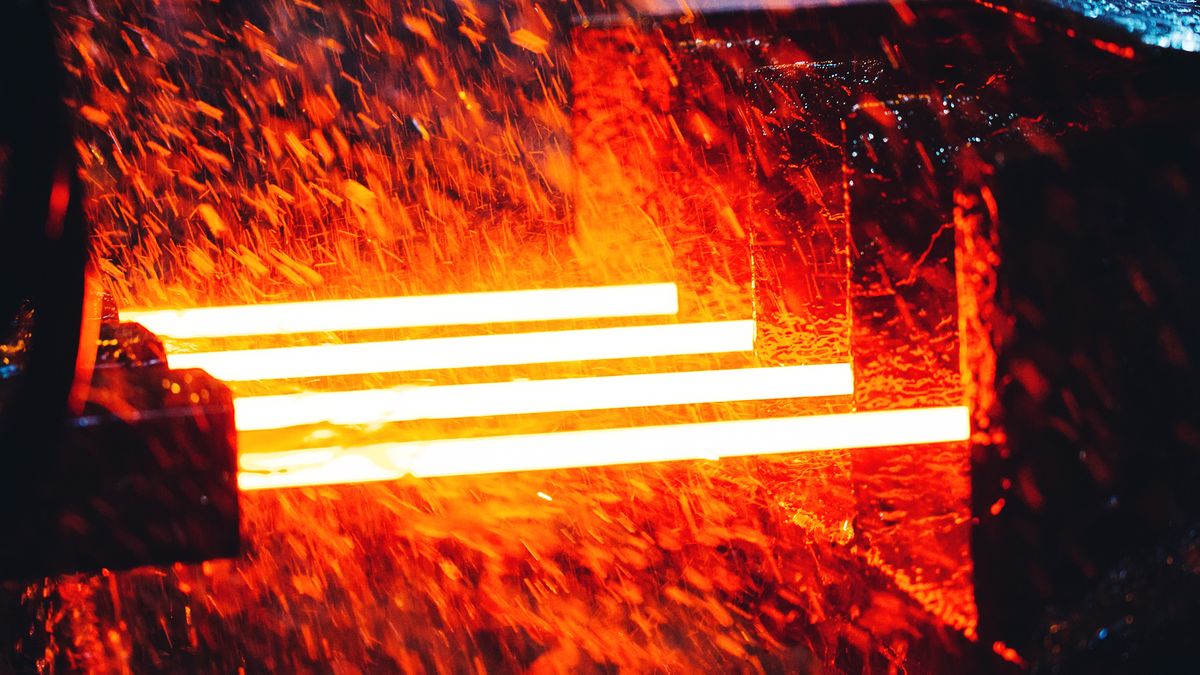
If you work in steel production, procurement, or equipment selection, you know what a rolling mill produces. What follows is a precise walkthrough of how it works at each stage, from input material to finished product, and where the process routes for bar mills, section mills, and wire rod mills go their separate ways.
Input Material: Billets and Blooms
Bar mills and wire rod mills typically process continuously cast billets, most commonly in the 100 x 100mm to 160 x 160mm square range. Section mills rolling H-beams, wide-flange sections, and heavy channels generally start from blooms, which are larger cross-sections typically at 200mm and above, to provide the volume needed for flange and web geometry.The condition of input material when it enters the furnace has a real effect on energy consumption and throughput. Steel arriving from a co-located caster still retaining heat from casting enters the furnace at around 650-700°C. Compared to cold charging from ambient, hot charging reduces furnace heating time from roughly 135 to 105 minutes, saves approximately 0.55 GJ of fuel per tonne, and increases furnace productivity by around 28%. Mills sourcing billets externally operate on cold charge by necessity, but where a caster is integrated, the case for hot charging is well established.
The Reheating Furnace
The reheating furnace brings input material to a uniform temperature suitable for plastic deformation, typically 1,100-1,250°C for most carbon and low-alloy steels. Target exit temperature is governed by rolling speed, stock cross-section, and steel grade. Too low and rolling loads increase sharply, with accelerated wear on rolls and drive components. Too high and scale loss increases, yield drops, and energy is wasted.Modern long product mills predominantly use walking beam furnaces. Unlike pusher furnaces, where billets remain in continuous contact with the hearth, walking beam furnaces advance material by lifting billets clear and stepping them forward. This eliminates the contact marks that pusher furnaces leave on billet undersides, which matters for products with tight surface quality requirements.
One thing that experienced operators know but newer engineers sometimes underestimate: peak temperature is only half the story. A billet that is correct at the surface but significantly cooler at its core will deform unevenly during rolling, producing dimensional variation and inconsistent mechanical properties in the finished product. Getting the cross-section temperature uniform is just as important as hitting the right number.
Descaling
Steel exiting the reheating furnace carries iron oxide scale formed during heating. At temperatures above 570°C this scale is composed of FeO (around 90%), Fe3O4 (around 8%), and Fe2O3 (approximately 1-2%). If it is not removed before rolling begins, it gets pressed into the bar surface and cannot be recovered downstream.High-pressure water jets remove the scale immediately before entry to the roughing mill, at working pressures up to 450 bar and water volumes of 200-700 m³ per hour depending on mill size. On higher-quality product lines, inter-stand descaling is applied again at intermediate stages to remove secondary scale formed between passes.
This step is worth taking seriously. Descaling nozzle condition and spray geometry have a direct effect on finished surface quality, and on older mills, degraded descaling systems are one of the most common and underappreciated sources of product non-conformance.
Roughing and Intermediate Rolling
After descaling, the billet enters the roughing mill for primary cross-section reduction. For long products, this is carried out in two-high or three-high reversing stands, with the billet passed back and forth through a series of calibers. These are shaped grooves in the roll face that progressively reduce the cross-section and elongate the bar, with each caliber pair in the pass schedule designed to distribute deformation evenly.After roughing, the bar enters a continuous intermediate train of typically 4-8 stands. In a continuous mill the bar occupies multiple stands simultaneously, so tension and loop control between stands is critical. Too much tension between stands pulls the cross-section down; too little and looping occurs, which causes dimensional variation and cobbles. Automated looper systems manage this in real time on modern installations.
Temperature drops steadily from furnace exit through roughing and intermediate rolling. Finishing must be completed above the critical transformation temperature for the steel grade, and managing rolling speed, pass schedule, and inter-stand cooling to stay within that window is a discipline that runs through the full mill sequence.
Where Bar, Section, and Wire Rod Mills Diverge
The three process routes share the furnace, descaling, and intermediate rolling stages. From finishing onward, they work in genuinely different ways.Bar Mills
Bar mills finish in stands delivering the final profile through calibers matched to the target cross-section, whether round, square, deformed rebar, or hexagonal. For rebar production specifically, the key piece of equipment is the quench box.As the bar exits the finishing stand, it passes through a water quench that rapidly cools the surface, forming a hard martensitic shell. The hot core then conducts heat back through the surface and self-tempers the martensite, producing a bar with a hard outer ring and a ductile pearlitic-ferritic core. This is how HRB400 and HRB500 grade rebar achieves its mechanical property profile through controlled in-line heat treatment, rather than alloying. It is a neat piece of metallurgical engineering that is easy to overlook because it happens in a matter of seconds on the mill floor.
Bars run onto a walking beam cooling bed, typically 100-150m in length, before cold shears cut to commercial lengths.
Section Mills
Rolling structural sections such as H-beams, I-beams, channels, and angles requires universal mill stands that use both horizontal and vertical rolls working simultaneously. This allows the flange and web of an H-beam to be reduced together in a single pass, something that two-roll caliber rolling simply cannot achieve geometrically.A typical heavy section sequence runs through a breakdown mill, then a universal rougher and edger operating in tandem over multiple reverse passes, and finally a finishing universal stand that delivers the specified profile. Cooling after rolling needs careful management: the difference in mass between the web and flanges of an H-beam or I-beam makes these sections susceptible to camber and residual stress if they cool unevenly.
Wire Rod Mills
After intermediate rolling, rod enters a no-twist finishing block, typically 8-10 stands arranged at alternating 45-degree angles. The 45-degree arrangement eliminates the twisting forces that would otherwise limit rolling speed in a conventional stand sequence, and this is what makes the high-speed finishing of wire rod possible.Modern wire rod finishing blocks operate at 80-110 m/s as standard, with development work pushing beyond 130 m/s for ultra-fine diameters. To put that in perspective, bar mill finishing speeds are typically an order of magnitude lower. At wire rod speeds, maintaining dimensional tolerances of ±0.10mm through the finishing block is a serious engineering challenge.
The rod exits the finishing block through a laying head, which deposits it onto a controlled cooling conveyor. Conveyor speed and the opening or closing of insulating covers control the cooling rate, and the cooling rate is what sets mechanical properties in the finished coil. High-carbon and alloy grades are cooled slowly under closed covers to control microstructure and minimize decarburization. Plain carbon construction grades are cooled rapidly under open covers.
What Determines Finished Product Quality
Four variables govern quality across all long product process routes: temperature management from furnace exit to cooling bed; roll caliber design and condition; cooling control after the finishing stand; and scale removal effectiveness throughout. These are the engineering decisions built into every mill configuration, and they are where the difference between a well-specified mill and an underperforming one shows up most clearly in production output.Contact Darting to discuss the configuration best suited to your production requirements, or explore our bar and section mill and wire rod and coil mill solutions.
Frequently Asked Questions
What is the difference between a billet and a bloom in hot rolling? Both are semi-finished steel inputs to a hot rolling mill, but they differ in cross-section size. Billets are smaller, typically 100-160mm square, and are the standard input for bar mills and wire rod mills. Blooms are larger, generally 200mm and above, and are used as input for section mills rolling heavy structural products such as H-beams and wide-flange sections, where greater material volume is needed to fill the finished profile geometry.Why does temperature uniformity in the reheating furnace matter for finished product quality? A billet that is at the correct surface temperature but significantly cooler at its core will deform unevenly as it passes through the rolling stands. Differential deformation produces dimensional variation across the bar cross-section and inconsistent mechanical properties in the finished product. This is why walking beam furnace technology, which achieves even heat distribution without contact marks, is the preferred choice for modern long product mills.
What makes TMT or HRB-grade rebar different from ordinary hot-rolled bar? The difference is the quench box at the finishing stand exit. As the bar leaves the last finishing stand, it passes through a water quench that rapidly cools the surface, forming a hard martensitic shell. The still-hot core then conducts heat back through the surface, self-tempering the martensite to a tougher structure. The result is a bar with a hard outer ring, a transitional layer, and a ductile core, meeting the yield strength and ductility requirements of HRB400 and HRB500 grades without relying on alloying additions.
Why do wire rod mills run at much higher speeds than bar mills? The no-twist finishing block used in wire rod mills, with stands arranged at alternating 45-degree angles, eliminates the twisting forces that limit rolling speed in conventional stand sequences. This allows finishing blocks to operate at 80-110 m/s, compared to the much lower finishing speeds typical of bar mills. The smaller cross-sections being produced also mean the bar is light enough to be handled at these speeds through the laying head and onto the cooling conveyor.
How does controlled cooling on a wire rod mill affect the final product? The cooling conveyor after the laying head is where the mechanical and metallurgical properties of the wire rod coil are set. Conveyor speed and the positioning of insulating covers control how quickly the rod cools through the microstructural transformation range. Slow cooling under closed covers produces the pearlitic microstructure required for high-carbon grades such as spring wire, tire cord, and cold heading wire, minimizing decarburization and allowing downstream processing without additional heat treatment. Fast open-air cooling is used for plain carbon construction grades where a mixed microstructure is acceptable.