
How to Choose a Flying Shear for a Bar Mill
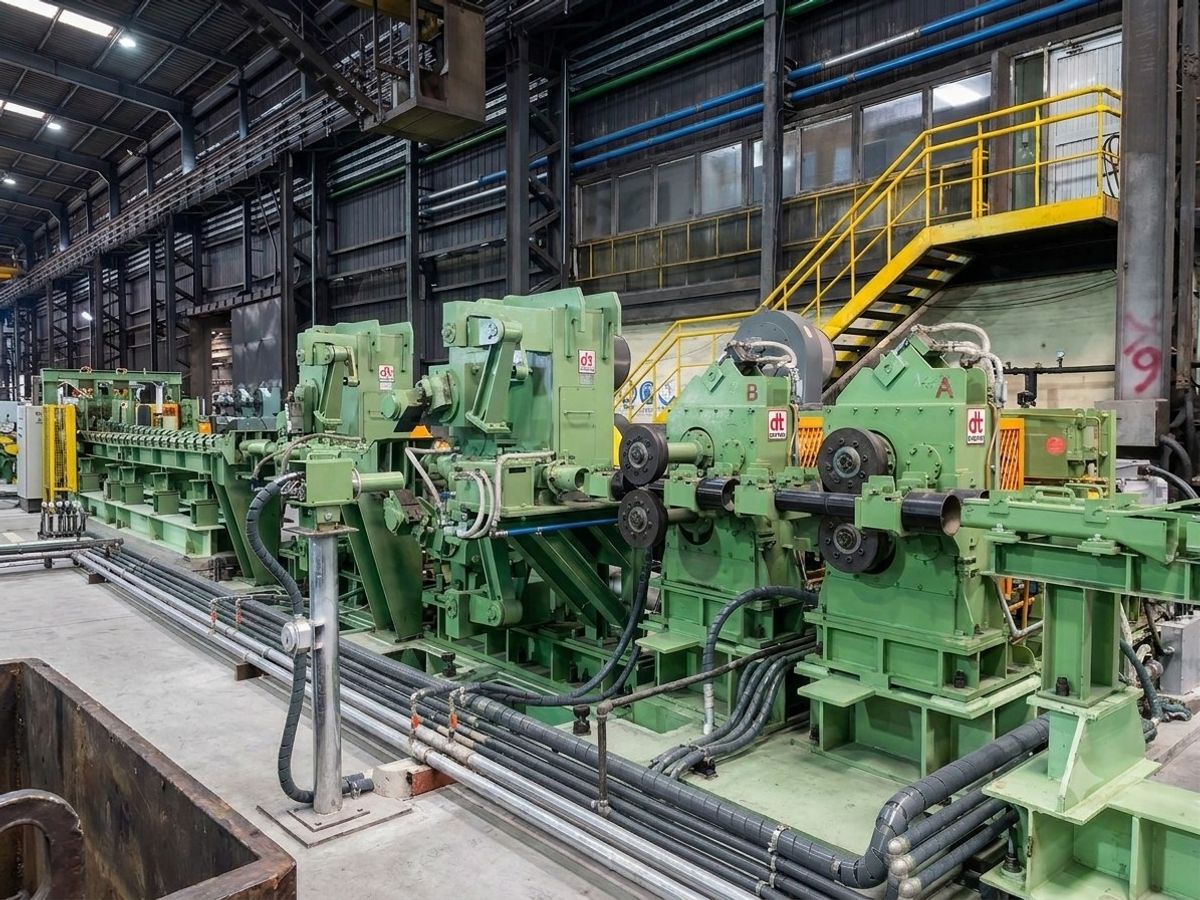
A flying shear cuts hot steel while it is still moving at rolling speed, cropping the head and tail, dividing bars to cooling bed length, and cutting the bar out of the line during a cobble. Choosing one means matching the shear type and its control system to your product range and rolling speed.
Darting has been building bar and section mills and the shears that go in them from Taichung since 1972, and the operators we work with tend to give the shears less attention than the stands, the reheating furnace, or the automation package. That’s understandable, since the stands are what shape the product and the furnace is what costs the most to run. The shear only becomes interesting when something goes wrong with it, and by then the symptoms usually show up somewhere else: bundles that fail length checks, a cold shear area that spends its time correcting what arrived from the hot side, or a cobble that took longer to clear than it should have.
If you’re specifying a shear for a new line, or looking at bar and section mill parts to bring an existing one back into service, it’s worth being clear about what the machine is actually being asked to do before you compare quotations. The rest of this article sets out the jobs a flying shear performs, the types available and where each one sits, the questions that decide which is right for your line, and how to judge whether an underperforming shear needs replacing or only a new control system.
What a Flying Shear Does in a Bar Mill
A flying shear performs three separate jobs in a hot rolling line, and a shear chosen well for one of them can still be poorly suited to another. The machine is mounted on a carriage that follows the bar at synchronous speed during the cut and then returns to its home position to wait for the next one, which is what allows the line to keep rolling while the cut is made.Cropping the head and tail
Bars leaving the roughing or intermediate train arrive with off-gauge front and tail ends, and these have to be cut off and discarded before the material enters the next train. Cropping accurately matters to yield rather than to quality: cut too generously and you’re scrapping saleable steel on every bar, cut too little and off-gauge material carries forward into the finishing stands, where it can damage guides and rolls.Dividing to cooling bed length
The dividing cut sets the length that arrives at the cooling bed, and it is normally made by a shear installed just before the bed entry, designed to work at the lower surface temperatures the material has reached by that point. Get this cut wrong and the effects run through the whole finishing area, since bars that do not match the bed and the cold shear layout cause crowding on the bed, waste at the cold shear, or both. We covered the downstream side of this in our article on choosing the right cooling bed for a bar or section mill, and the two decisions really should be taken together.Cutting out a cobble
When the line cobbles, the shear is what stops a bad situation becoming a long one, chopping the incoming material so that it can be cleared rather than allowing it to pile up in front of the stand. A shear that hesitates here, or that cannot cut reliably at full rolling speed, turns a short stoppage into a shift-long one, which is the sort of cost that never appears in the equipment comparison but shows up clearly in the monthly output figures.Which Type of Flying Shear Suits Your Mill
Shear types differ mainly in how the blades are driven and whether they run continuously or start and stop for each cut, and those two things largely determine the speed range and the cut quality you can expect. The main designs used in bar and section mills are set out below, following the classification used in this reference on shearing processes and shear types.| Type | How it works | Typically suits | Points to weigh |
|---|---|---|---|
| Crank, start-stop | Motor and gearbox permanently connected; blades accelerate, synchronize with the bar, cut, decelerate, and reposition | Cropping and dividing at low to moderate speeds | Cut quality is good because the blades meet the bar squarely; accuracy depends heavily on blade position control |
| Crank with clutch and brake | Flywheel drives the blades through a pneumatic clutch and brake | Older lines, cropping and cobble cutting | Accuracy and repeatability are limited by clutch and brake condition; friction material is a recurring wear item |
| Rotary, continuous | Blades rotate continuously on drums; a diverter directs material into the blades | Crop, tail, and emergency cutting at lower speeds | Lower cost and mechanically simple, and generally used where cut-to-length precision is not the main requirement |
| Rotating, high speed | Optimized motion control of rotating blades combined with a fast diverter | High-speed lines needing crops, scrapping, and cut-to-measure | The most capable and the most demanding to control, since blades and diverter have very different inertia |
| Drum | Blades mounted on a rotating drum, set at a lead speed relative to the bar | Simple shapes such as flats and rounds | The lead speed setting is what keeps the bar from kinking at the cut |
| Pendulum | Cutting system suspended in an oscillating frame | Cropping or dividing, on moving or stopped material | Useful flexibility where the material may be stationary at the cut |
| Dual system | Two cutting systems, crank rotary and crank lever, in one movable frame | Cooling bed shears handling both bar and section | The frame moves across the rolling line to bring the required system in line, which adds capability and mechanism to maintain |
Sections generally favor the crank lever arrangement, because an angle or a channel doesn’t tolerate the same handling as a round bar, while rounds and flats are the natural application for drum designs. If your mill rolls both, a dual system shear or a pair of shears is a more honest answer than trying to make one mechanism cover everything.
How Do You Match a Shear to Your Line
The right shear for a line is determined by five things: the product range, the material speed at the shear position, the cut length tolerance you have to hold, blade access, and the layout of the finishing area on either side. Working through them before you approach suppliers will get you better proposals than an inquiry based on bar size alone.Product range, now and later
Start with the full list of what the mill will roll, including the sizes you expect to add rather than only those on the order book today. Rebar, rounds, flats, angles, and channels put different demands on the blades and on the way the material is presented to them, and a shear sized only for the current range tends to become the reason a new product is turned down two years later.Rolling speed at the shear position
The speed of the material at the shear, not the finishing speed of the mill, is what determines which designs are viable. Crank shears work well at modest speeds and give a clean cut there, whereas continuously rotating designs with optimized motion control are what high-speed lines rely on, and they can handle crops, scrapping, and cut-to-measure at speeds well beyond what a crank mechanism will manage.Cut length accuracy
Cut length tolerance is a commercial requirement before it is a technical one, since rebar and merchant bar are supplied to standard cut lengths under specifications such as ASTM A615/A615M, and short bars are rejected while long ones are steel given away. Accuracy comes from the control system rather than the mechanics: an incremental encoder on the stand motor tracks material position, a second encoder on the shear tracks blade position, a hot metal detector identifies the head and tail of the bar, and a proximity switch resets the shear position at the moment of the cut. If any one of those is drifting, the cut length drifts with it.Blade life and blade changing
Blade condition governs cut quality directly, because dull blades leave ragged edges, and blade clearance, usually somewhere between 2 and 10 percent of the section thickness depending on the material, determines whether the edge comes off clean or with rollover and burr. Two practical points follow from that. Someone has to be able to reach the blades safely and set the clearance without a long shutdown, and the blades themselves belong in your stock plan rather than in an emergency order, which we discussed in more detail in our article on planning spare parts inventory for a rolling mill.Fit with the rest of the finishing area
The shear has to work with the equipment on either side of it, so the dividing cut length, the cooling bed, the cold shear, and the bundling and packing area need to be considered as one arrangement. If you would like the wider picture of how these stages connect, our explanation of how a hot rolling mill works covers the sequence from reheating through to finishing.When Is It Worth Upgrading Rather Than Replacing a Shear
Many shears that are performing badly are mechanically sound, and on a start-stop shear in particular it is often unnecessary to replace the whole system when a new motion control system applied to the existing drive will restore the accuracy. That’s worth establishing before you price a replacement, because the difference in cost and in downtime is considerable.Some symptoms point to control rather than mechanics. Cut lengths that vary from bar to bar while the machine sounds and looks healthy usually indicate a tracking or timing problem, and on older clutch and brake shears the repeatability is limited by the clutch and brake themselves, though a new control system will still reduce the electrical component of the error. Modern motion control also brings some quieter benefits that operators notice over a season rather than a shift, including less mechanical stress on the drive train, lower noise, and reduced energy use.
Other symptoms point the other way. Blade holders that no longer hold clearance, worn carriage guides, cracked frames, and gearboxes with play in them are mechanical problems that no amount of control work will correct, and a shear that cannot physically cut your largest section at speed was specified for a different mill than the one you are now running. Where the mechanics are sound but the capability is not, a rebuild with new blades, holders, and controls is often the sensible middle course, and it is the kind of work that suits reverse engineering when the original supplier no longer supports the machine.
If you are unsure which category your shear falls into, the cheapest diagnostic is usually a period of length measurement on finished bundles alongside a check of the encoders and hot metal detector, since that will separate a control fault from a mechanical one before anyone commits to a capital decision.
Frequently Asked Questions
Can an old clutch and brake flying shear be upgraded, or does it need replacing?A clutch and brake shear can usually be improved rather than replaced. Fitting a modern motion control system reduces the electrical error and improves cut repeatability, though the ultimate accuracy of a clutch and brake shear remains limited by the condition and timing of the clutch and brake themselves. If the frame, carriage, and drive train are sound, an upgrade is normally the more economical route.
What causes cut length to vary from bar to bar?Cut length variation usually comes from the position tracking rather than the cutting mechanism. The encoder on the stand motor, the encoder on the shear, the hot metal detector, and the shear proximity switch all feed the axis control, and a fault or drift in any of them will move the cut. Blade wear and incorrect clearance affect edge quality more than length.
How often do flying shear blades need changing?Blade life depends on the sections being cut, the material grade, the cutting temperature, and how well the clearance is set, so no single interval applies across mills. The practical approach is to record blade life on your own products, then hold enough blades in stock to cover a planned change plus one unplanned one.
Can one flying shear handle both rebar and structural sections?One shear can sometimes handle both, though rarely equally well. Rounds and flats suit drum and rotary designs, while angles and channels are usually better handled by a crank lever arrangement, which is why dual system shears carry both mechanisms in a frame that moves across the rolling line. Darting supplies flying shears and cold shears for bar and section lines, so if your product range spans the two, it’s worth pricing a dual system shear against a pair of separate machines.
Does the flying shear need to match the cooling bed?Yes. The dividing cut sets the length that arrives at the bed, so if that length does not suit the bed width and the cold shear layout, you’ll see crowding on the bed, extra waste at the cold shear, or slower discharge, none of which is fixed by adjusting the shear alone.
What accuracy can a modern flying shear achieve?Shears controlled through a PLC with proper position feedback hold close cut length tolerances, and start-stop and cooling bed dividing shears are commonly specified on that basis. The figure that matters is the tolerance your customers and standards require, so it’s worth putting that number in the inquiry rather than asking suppliers what their machines can do.
Darting has designed, built, and reverse engineered flying shears, cold shears, and the blades, jaws, and drives that go with them for bar and section mills since 1972, and our workshop in Taichung handles both new machines and rebuilds of equipment whose original supplier has moved on. If you take length measurements from your finished bundles and the numbers point at the hot side, we’re happy to look at what you have and tell you whether it is a control problem or a mechanical one before you budget for a replacement.